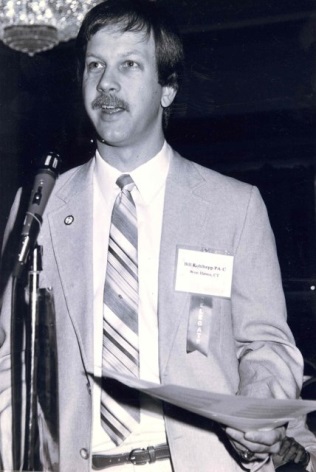

William Kohlhepp became the 17th president of the PA History Society, taking office in January 2026. He joined the PAHx Board in 2021 and served as secretary/treasurer in 2023 & 2024.
Kohlhepp’s involvement in PA professional organizations began in 1977 and has continued ever since. His interest in serving the profession was initially sparked by his participation in the fight for PA enabling legislation in New Jersey, a state in which he grew up and only left to complete his undergraduate work at the University of Connecticut in 1974. In 1977, he enrolled in the third class of the Rutgers University/University of Medicine and Dentistry of New Jersey (UMDNY) Physician Assistant (PA) Program.
A year into his education, it became clear there was a need to advocate for licensure of PAs in New Jersey. Though students could enroll and graduate from a PA program in New Jersey, they could not legally work within the state once they graduated. Kohlhepp and several of his classmates stepped forward and formed the Physician Assistant Student Society of New Jersey in the fall of 1977. Soon thereafter, he and Maryann Ramos, one of the few PAs working in the state at the time, started the New Jersey State Society of Physician Assistants. In October 1978, Kohlhepp testified as a student before the New Jersey State Assembly’s Institutions, Health, and Welfare Committee in support of PA practice legislation. After graduating in 1979, Kohlhepp moved to Connecticut but continued to fight for enabling legislation in New Jersey. He chartered a bus and organized the Connecticut contingent that participated in the 1989 “March on Trenton” in support of New Jersey PA legislation.
Kohlhepp’s engagement in advocacy for effective PA practice shifted to Connecticut with his move and has spanned his career. In the early 1980s, he testified before the Connecticut State Legislature’s Public Health Committee in support of the initial enabling legislation for PAs in Connecticut. In 1985, Kohlhepp and one other member of the Connecticut Academy of Physician Assistants (ConnAPA) successfully advocated with the office of then Attorney General Joe Lieberman for a favorable legal opinion which influenced PA practice in the state immeasurably at the time. In 1990, he testified before the Connecticut State Legislature’s Public Health Committee in support of an act allowing controlled substance prescriptive authority for PAs. The legislation was eventually adopted that year.
Kohlhepp started his PA career working in emergency medicine at the Yale-New Haven Hospital in New Haven, CT. In 1983, he became a primary health care provider at the Community Health Care Plan in New Haven, CT, where he eventually became a manager. In 1989, he moved on to become the operations manager of Occupational Health Plus at the Hospital of Saint Raphael in New Haven, CT.
In 1996, Kohlhepp became a full-time PA educator when he joined the faculty of Quinnipiac University in Hamden, CT. He served the PA program in many roles, advancing to higher levels of academic leadership within the program. He ultimately was appointed dean of the university’s School of Health Sciences in 2015. He stepped down from that position in late 2019 and retired from the university in 2020. His many roles at QU included time as associate director and academic coordinator of the PA program, the director of the pre-professional phase of the PA program, associate dean of the School of Health Sciences and associate vice president for faculty affairs. Upon his retirement, Quinnipiac conferred upon Kohlhepp the title of Professor Emeritus of Physician Assistant Studies. He holds a Master of Health Administration from Quinnipiac and a Doctorate in Health Sciences from Nova Southeastern University.
Kohlhepp has served on the ConnAPA Board of Directors in multiple roles since coming to the state; he has twice served as ConnAPA President (1983 and 1992). He then went on to serve as the president of three out of the four major national PA organizations: AAPA, NCCPA, and PAEA.
Kohlhepp served as a American Academy of PAs Student Academy Board Member (1978) and went on to serve the AAPA as vice president (1996, 1997 and 1998), president-elect (1999), president (2000) and board chair (2001). For the AAPA House of Delegates, he served as secretary (1992), second vice speaker (1993), first vice speaker (1994 and 1995), and speaker (1996, 1997 and 1998). During his time on the National Commission on Certification of Physician Assistants (NCCPA) Board of Directors (2001-2009), he served as chair-elect (2005), chair (2006) and immediate past chair (2007). During his time with NCCPA, Kohlhepp also chaired the committee that would lead the effort of the four major PA organizations to draft the first set of Competencies for the PA Profession (2005). He served on the workgroups that revised the competencies in 2012 and 2020. With the PA Education Association (PAEA), he served on the board of directors as secretary/treasurer (2010-2015) and president (2006). Interestingly, he had been the PAEA representative during his days with the Student Academy (1978-79).
During his time as AAPA Speaker, Kohlhepp took the lead in efforts to change AAPA governance to add specialty organizations as voting members of the HOD and to increase HOD roles in governance. As AAPA President, Kohlhepp traveled to the White House in 1999 to participate in the release of the first Surgeon General Report on Mental Health. In 2000, Kohlhepp, AAPA Past President Ron Nelson and AAPA staff member Michael Powe met with high level officials at the Centers for Medicare and Medicaid Services to discuss the use of high level evaluation and management CPT® (Current Procedural Terminology) codes by PAs. During his time as AAPA President, he also met with the Health Care Finance Administration (HCFA)’s administrator to discuss Medicare reimbursement. While serving as NCCPA Chair, Kohlhepp represented the organization at the National Institute of Health (NIH) National Human Genome Research Institute to discuss PA roles. Kohlhepp has twice testified before Congress. In 2005, Kohlhepp testified on behalf of AAPA before the United States House of Representatives Subcommittee on Workforce Protections. The hearings explored amending the Federal Workers’ Compensation Act to allow clinical practices to be reimbursed when PAs provide care to injured federal workers. In 2017, Kohlhepp again testified on Capitol Hill, this time on behalf of PAEA when he went before the House Appropriations Subcommittee on Labor, Health and Human Services, Education and Related Agencies to urge action on clinical education sites. Later that year, Kohlhepp joined then PAEA CEO Timi Agar-Barwick to meet with newly appointed Health Resources and Services Administration (HRSA)’s administrator, Dr. George Sigounas, to discuss Title VII PA education grants https://paeaonline.org/resources/public-resources/paea-news/paea-meets-hrsa
Kohlhepp is well published in peer-reviewed clinical and academic journals and has co-authored three textbook chapters. He has given many invited educational, clinical and professional presentations at state and national events. For a list of scholarly works Dr. Kohlhepp has authored or co-authored, please visit his Google Scholar Profile.
Kohlhepp has been recognized for his clinical, academic and volunteer achievements. In 1985, he was the recipient of the Outstanding Service Award from the AAPA House of Delegates. The School of Health Related Professions at the University of Medicine and Dentistry of New Jersey acknowledged his achievements with the 1999 Distinguished Alumnus Award. He was named the 2006 PA of the Year by the AAPA Occupational Medicine Caucus. Kohlhepp became a Distinguished Fellow Member of the AAPA in 2008. In 2009 he received an Honorary Doctor of Humane Letters Degree from the AT Still University in Mesa, Arizona. The Student Academy of the AAPA awarded him the Student Academy President’s Award in 2010. Over the years, Kohlhepp has on multiple occasions been recognized by ConnAPA for his many contributions. In 2019, he was recognized as ConnAPA’s PA of the Year In 2023, he received the PAEA Lifetime Achievement Award.
In retirement, Bill Kohlhepp enjoys traveling with his wife, Peggy. He also enjoys having much more time to spend with his family, particularly his four grandchildren and their parents. Sailing and golf occupy his summer days while QU hockey and UConn basketball get him through the winter.
To read PAEA’s article, Celebrating 50 Years: William C. Kohlhepp Past President Snapshot, please click here.
Click here to watch an interview Dr. Kohlhepp gave the PA History Society in 2016.
To watch an interview with Dr. Kohlhepp from the ATSU DMSc MasterClass series, please click here.
Acknowledgments: This Biographical Sketch was initially prepared by the late J. Jeffrey Heinrich, PA-C, EdD and edited by William C. Kohlhepp, DHsc, PA-C and submitted to the Society on July 6, 2015. The biography was updated in January 2019 and February 2026. The portrait photograph is courtesy of Dr. Kohlhepp and the banner and second photographs are from the AAPA photographic collection, PA History Society, Johns Creek, GA.
When using information from this biography, please provide the proper citation as described within the PA History Society Terms of Use.